Creative and Credible: Assessing Value
This paper gives a brief introduction to the issues and techniques used for assessing value, including economic evaluation and social return on investment.



This paper gives a brief introduction to the issues and techniques used for assessing value, including economic evaluation and social return on investment.
Even the smallest scale project evaluation involves some kind of monitoring. The purpose of this is to document project delivery, usually recording the numbers taking part, the settings where the activities took place, the types of activity offered, and the outputs from the activity, including creative outputs such as artworks, music and performance. This often … More
It can be challenging to make time and resources available for evaluation, which can sometimes seem costly in relation to the overall project costs. However, it is increasingly important to factor in evaluation costs when planning projects, particularly if these are envisaged as having a role to play in supporting health and wellbeing or meeting … More
Good practice can be demonstrated in relation to each stage of the evaluation cycle (Daykin et al. 2013). Although there are no agreed codes of practice or ethics for evaluators, as there are for researchers, some key principles emerged from the Creative and Credible Project.
This document by Creative and Credible outlines the different purposes of evaluation and explains the differences between different evaluation models and approaches.
Examples of Creative Evaluation Techniques.
This is a tool to make the daily evaluation in a funny and impressive way: each participant will draw a scene that represent the day, then all the scenes will be put together to create a film about the liking of the activities for the whole group.
Podcasting a live event can be a great way to make your valuable event reach more people though the power of audio. It can help showcase the work and document the event for future listening.
This guide has been created by Adam Zmith, Co-founder of Aunt Nell, Producer of The Log Books and The Film We Can’t See.
It is a guide for film programmers / event managers / tech people working in cinemas who want to make a podcast out of their live events. It has been created for our T.L.C (aka Tender Loving Care for Trans-Led / Trans-Loved Cinema) series of events and podcasts. The is aimed at people who would like to create a podcast and are running live events in cinemas where there will be a PA/sound system and assistance from a tech person.
This guide intends to give you broad headings for everything you need to think about, some answers for how to make it all happen, and links out to further information.
Download the How To Podcast Your Live Event guide
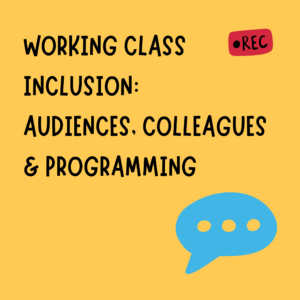
Inclusive Cinema’s podcast series, Working Class Inclusion: Audiences, Colleagues & Programming, provides information and guidance to support exhibitors in improving cinema experiences for working-class people and those in poverty.
The resource comprises a series of six podcast episodes that cover a range of areas, from sliding-scale ticketing and equitable employment practices, to the films that are programmed and how they are presented.
There is also an access and inclusion checklist to support venues, festivals, industry initiatives and event organisers with strategic and operational measures to welcome working-class audiences and colleagues.
The series is presented by Dr. Leanne Dawson, senior lecturer in Film and Diversity and Inclusion Consultant.
The resources are intended as a practical guide to support cinemas, festivals and film exhibitors to welcome working class people as audiences and staff to their venues and increase access to independent cinema for all.
Working through these 6 short podcasts we hope you can find ideas and understanding of barriers for working class people, with a view to increasing access in cinemas, and offer a chance to reflect on where your venue is currently at.
Click on each link to listen to all 6 podcasts
You can download the transcript for each episode from the downloads section.
This introductory episode explores some issues with working class inclusion such as how we define class and that the term ‘working-class’ groups many different experiences together.
What to reflect on your organisation and how it can take small, cost-free measures to improve it’s welcome to working class people.
What to reflect on whilst working on Equality, Diversity and Inclusion EDI) in your organisation.
Consider the barriers you create that prevent people entering and/or enjoying your space or event.
How to include a spectrum of working class representation onscreen.
How to ensure you have working class employees at all levels of the organisation.
You can listen to all six podcast episodes of Working Class Inclusion: Audiences, Colleagues & Programming here:
Coming soon to:
We have provided a checklist of measures as suggested in the podcasts to provide your staff and venue with an easy point of reference when considering inclusion of working-class people in your work.
You can find this in the downloads section on this page.
We have provided a list of film suggestions which can be used for ideas and inspiration for film programmers when considering working-class representation in cinema. We’ll be updating this with distributor/access materials information as this comes in (until the end of March 2023).
You can find this in the downloads section on this page.

If you’ve ever thought about how to engage young audiences aged 16-30 but have been unsure where to start or even if you’ve begun work in this area but are now thinking about how to take it to the next level, then this is the resource for you.
Film Hub London is Young Audiences lead for FAN and we have been listening to and learning from the incredible FAN members delivering this work at venues, festivals and film societies across the UK. For this guide – FAN’s ‘Guide to Working with Young People’ – Moira McVean (FAN Young Audiences Manager) in collaboration with FAN Young Consultant Thea Berry has gathered case studies and examples of many of the ways you can bring young people and youth voice into your venue to authentically support you in engaging young people as young audiences for independent film.
The guide is split into chapters that highlight ways in which you can work with young people and throughout you’ll find links to supporting documents and further guidance. We’ve also included plenty of real-world quotes from both young people and venue management to help with board conversations and advocacy for the benefits of this work. Crucially, everything recommended is evidence based and grounded in research.
The introduction references research documents that have helped us determine the key barriers to young people’s attendance at independent venues with statistics that point towards the business case for young audience development.
It’s possible to read this guide as a journey that a young person could take with your organisation. Beginning as a focus group participant, moving to becoming a young writer and reviewer and onwards to Youth Advisory group member, Young Trustee, Mentee and Mentor. We have also gathered a range of case studies from across FAN detailing Young Programmer initiatives and examples of how these groups have led to the formation of independent film collectives.
So, with this resource we also want to encourage you to think about opening your venue’s doors and handing over your curatorial reigns to takeovers by these young collectives, youth led festivals and film clubs.
Significantly, all the practitioners we invited to contribute have highlighted one over-riding message and that is that to effectively attract young people to your venues and events, it is essential that you involve them in the design and development of your programmes and spaces. Therefore, our intention for this resource is to inspire and encourage more of the FAN membership to embrace and experiment with working with young people. We believe that by working with young people, taking on board their suggestions and advice and innovative ways of thinking, that the rewards will include welcoming young people into your venues as new audiences for independent film.
Download BFI FAN – GUIDE TO WORKING WITH YOUNG AUDIENCES.pdf